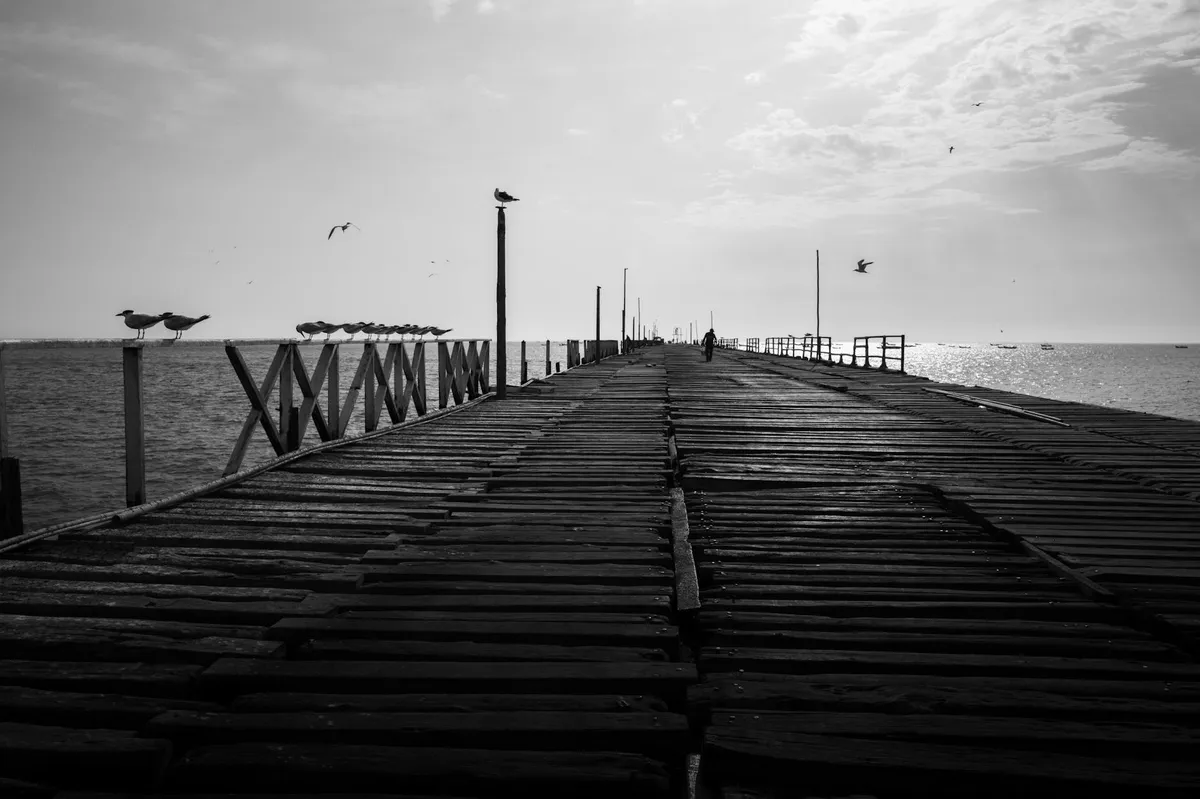
The first thing to understand about the Boardwalk is that it is, in the literal engineering sense, a piece of public infrastructure made of wood and steel laid down across sand. It is approximately four miles long. It is, depending on which section you stand on, somewhere between forty and sixty feet wide. It rests on a substructure of pressure-treated piles that go down through beach sand into something more substantial, and it carries a deck of southern yellow pine planks that get replaced on a rolling schedule that the city's public works department has worked out across decades of trial and error.
The planks are not laid with the long axis parallel to the ocean, which is the layout most visitors assume. They are laid in a herringbone pattern, with the planks running diagonally relative to the length of the Boardwalk. The choice was made early in the structure's history and has been preserved through every rebuilding since. The reason is that diagonal planking distributes the load more evenly across the substructure and produces a walking surface that is somewhat more forgiving underfoot than parallel planking would be. The pattern is also marginally easier to repair, because individual planks can be replaced without disturbing the structural relationship between adjoining planks.
The original construction and its successors
The first Boardwalk was built in 1870. The motivation, as is usually told, was that hoteliers along the beach were tired of beach sand being tracked into their lobbies by their own guests. The first version was eight feet wide and twelve feet long in sections that could be taken up at the end of the season and stored for the winter. It was, in other words, less a permanent structure than a piece of seasonal infrastructure that the hotels collectively maintained.
The expansion to a permanent year-round structure happened through a sequence of rebuildings over the following decades. The version that most visitors think of as the Boardwalk — wider, raised on substantial piling, continuous from the inlet to the southern end of the city — was substantially the work of the 1890s and the early years of the twentieth century. The structural philosophy that guided those rebuildings has carried through to the present. The Boardwalk is engineered to flex with the substrate, to accept the storms that periodically batter the eastern seaboard, and to be repaired in sections when sections need repair.
The major reconstructions since have been driven principally by storm damage. The 1944 hurricane, the 1962 storm, and Superstorm Sandy in 2012 each removed substantial sections of Boardwalk and required substantial rebuilding. The post-Sandy reconstruction is the most recent, and it incorporated engineering changes that responded to what the storm had revealed about the structure's vulnerabilities. The piling depths were increased in some sections. The substructural connection details were modified to better accept lateral storm loading. The drainage was reworked to better handle the surge water that the previous design had concentrated in places where the deck planking gave way.
The architectural record along the length
The structures that have stood along the Boardwalk over its century and a half are an architectural record of American resort architecture across the period. The early structures were Victorian — wood-frame hotels in the Stick Style and the Queen Anne, with porches and turrets and the elaborate decorative carpentry that the period favored. Almost none of those structures survive. They burned, they were torn down, or they were lost in storms over the decades.
The early twentieth century brought larger and more permanent structures. The Marlborough-Blenheim, completed in stages between 1902 and 1906, was the first reinforced-concrete hotel of significant scale on the East Coast and became an architectural landmark of the period. It was demolished in 1978 to make way for one of the early casino properties. The Traymore, completed in 1915, was another reinforced-concrete structure of similar significance. It was demolished in 1972, before the casino-era construction began. Photographs of the demolitions are widely available and are worth the time to look at.
The Boardwalk's contemporary architectural character is the casino-era architecture — the large hotel-casino structures that were built in the late 1970s and through the 1980s and 1990s. The architectural quality varies considerably across the casino properties. Some were built with attention to how they would relate to the Boardwalk and to the urban fabric behind it. Others were built as essentially internal-facing structures that turn their backs to the Boardwalk and present blank walls or service entrances. The architectural decisions made during the casino-era construction shaped what the Boardwalk experience is today, in ways that continue to be debated.
The piers and what has happened to them
The piers that extend from the Boardwalk out over the ocean are a related architectural category with their own history. At the peak of the early-twentieth-century resort era, the city had several major piers — Steel Pier, Steeplechase Pier, Million Dollar Pier, the Garden Pier — each of which was a substantial structure with its own architectural identity and its own programmatic mix of entertainment and amusement.
The piers have been periodically destroyed by fire and by storms across their history. The Steel Pier has been rebuilt multiple times. The Garden Pier has been substantially modified and reduced from its original form. The Million Dollar Pier has been reconstructed under different ownership configurations and now houses a shopping mall and a restaurant complex. The Steeplechase Pier was lost in storms early in the twentieth century and not rebuilt.
The current piers are diminished in number and in scale from the historical peak. The Boardwalk has been correspondingly less defined by its piers than it once was, and the architectural relationship between the Boardwalk and the ocean has been altered as a result. The pier structures that remain are valuable as historical record and as continuing programmatic anchors along the Boardwalk's length, but they are not the architectural events they once were.
The maintenance regime and what it costs
The Boardwalk requires continuous maintenance to remain functional. The planks weather, warp, and require replacement on a rolling schedule. The substructure requires inspection and component replacement at less frequent but still substantial intervals. The drainage and the connections to the upland streetscape require attention. The total annual cost of Boardwalk maintenance is a substantial line item in the city's public works budget.
The maintenance is organized through the city's public works department with funding from a combination of city revenue, state contribution, and the special taxing arrangements that flow from the casino industry to the local infrastructure. The funding mix has varied across decades and is one of the practical political questions that determines what condition the Boardwalk is in at any given time.
The work itself is done by a small group of skilled tradespeople who know how the structure responds to weather, to load, and to the specific geometric details that affect how individual sections wear. The crew has institutional knowledge about the Boardwalk that does not get written down anywhere comprehensive. The continuity of that knowledge across staff turnover is one of the quiet operational challenges that the public works department manages.
What the Boardwalk does for the city
The Boardwalk is the most-photographed piece of public infrastructure in Atlantic City and probably one of the most-photographed in the United States. It is also, in the practical sense, the principal pedestrian connector along the length of the city. People walk it for exercise. People run on it. People ride it on bicycles in the early morning hours when the regulations permit cycling. It carries the rolling-chair traffic that has been a feature of the city since the late nineteenth century.
It is also a piece of public space in a city that has relatively limited other public space at this scale. The Boardwalk is where Atlantic City residents go for the kind of unstructured outdoor walking that other cities do in parks. The function is not advertised in the way that the casino traffic is advertised, but it is substantial.
The Boardwalk's continued maintenance is therefore not a quaint preservation question. It is a question about whether one of the most-used pieces of public infrastructure in the city continues to function. The answer, so far, has been yes. The work continues, the rolling plank replacement schedule is met or substantially met each year, and the structure persists as the principal pedestrian piece of the city's public realm. Whether it persists into the next half-century at the scale and condition it currently maintains is a question for the budget process and for the political will that the budget process reflects.