The beach at Atlantic City is, in the engineering sense, a managed feature of the coastal landscape. The natural shoreline of Absecon Island would not, absent active intervention, present the wide sandy beach that visitors and residents currently use. The beach as the city knows it is the result of a continuous engineering project that has been running for several decades and that depends on substantial periodic interventions to maintain its current form.
The replenishment work is rarely written about as a feature of Atlantic City's identity, but it is one of the most-substantial pieces of public infrastructure investment in the region and one of the most-direct examples of how the contemporary coast has been deliberately constructed. The history of how the project came to exist, what it has involved in operational terms, and what the future of the work looks like is worth understanding for anyone who cares about the city's coast.
The geomorphological context
Absecon Island, on which Atlantic City sits, is a barrier island. Barrier islands are dynamic landforms that respond to wave action, longshore sediment transport, and storm events with continuous physical change. The natural state of a barrier island is to migrate landward over time, to shift its sand distribution in response to seasonal and storm conditions, and to maintain its overall mass through sediment exchange with the surrounding coastal system.
The natural sand budget of Absecon Island, in the absence of human intervention, would not produce a wide, stable, sandy beach in front of the developed Atlantic City Boardwalk. The natural shoreline tendency, particularly given the developed urban infrastructure that constrains the island's ability to migrate or to rebuild itself naturally, is for the beach to narrow over time as wave action removes sand faster than the natural sediment supply replaces it. Without intervention, the beach would have been substantially narrower than the contemporary beach within decades of the post-war development period.
The replenishment work is the engineering response to this natural tendency. The work moves sand from offshore borrow sites onto the beach to maintain the beach width and elevation that supports recreational use, that protects the upland infrastructure from storm wave action, and that provides the visual and functional beach environment that the city's economy depends on.
The early replenishment history
The earliest substantial replenishment work along the New Jersey coast began in the early twentieth century, with smaller-scale projects responding to specific erosion concerns. The work expanded substantially in the 1960s and 1970s as the cumulative effects of beach narrowing became more visible and as federal coastal-engineering capacity developed.
The 1962 Ash Wednesday Storm produced substantial damage along the New Jersey coast and accelerated the engineering attention to the coastal-protection question. The post-storm reconstruction included several replenishment projects in Atlantic City and adjacent communities, with work that established methodological precedents for the subsequent larger-scale projects.
The federal-state cooperative framework that has structured most of the replenishment work since the 1980s emerged through legislative and administrative action across the 1970s and 1980s. The framework specifies a federal-state cost-sharing arrangement, project authorization processes, and the technical-design parameters that the work follows. The framework has been modified across subsequent decades but has retained its basic structure as the operational basis for the replenishment program.
The mechanics of how replenishment actually works
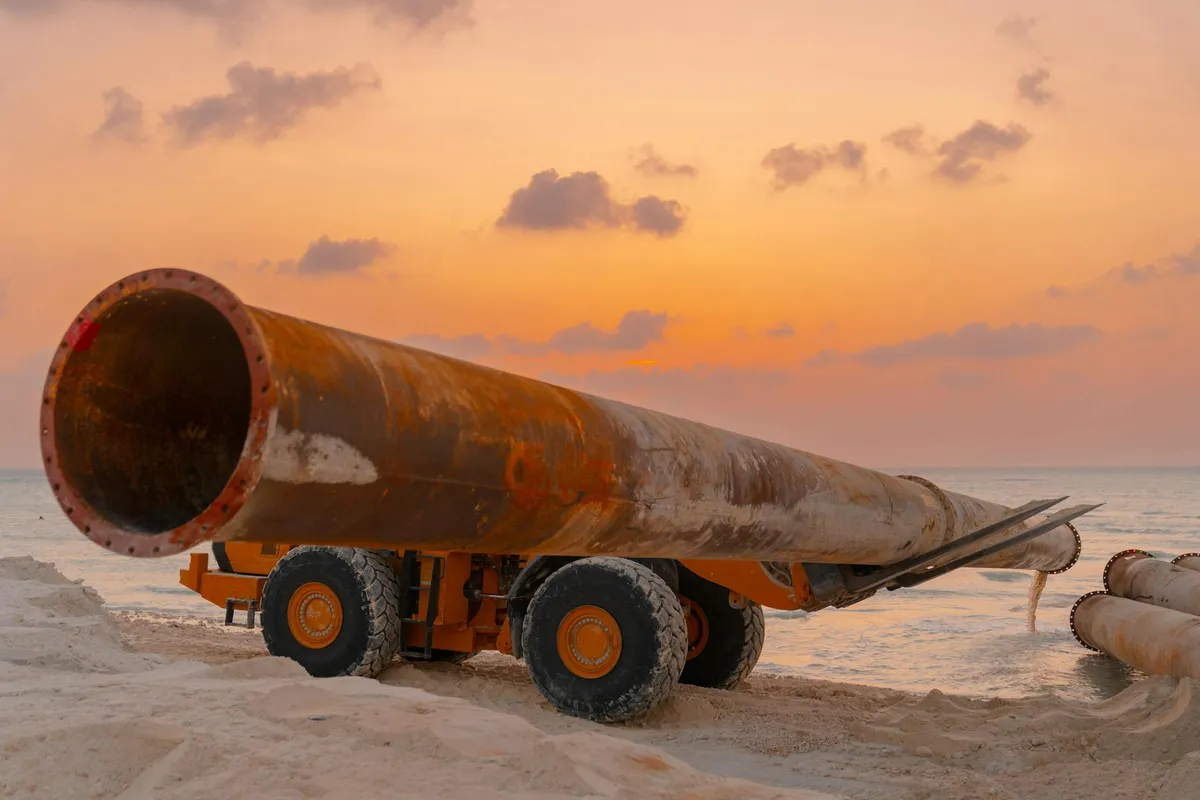
A typical replenishment project involves dredging sand from a designated offshore borrow area, transporting it to the beach site, and depositing it in a specific spatial pattern designed to produce the engineered beach profile. The work uses specialized dredging vessels, pipeline transport systems, and shoreline equipment that distributes the deposited sand to the design elevations.
The borrow areas are selected through environmental assessment processes that consider the sand quality, the ecological effects of the dredging, and the practical logistics of moving the sand from the borrow site to the beach. The selected borrow areas are typically several miles offshore in water depths and bottom conditions that the dredging equipment can work efficiently.
The deposition phase shapes the deposited sand into the engineered beach profile, which typically includes a wider beach face, a designed berm elevation, and a specific dune profile at the upland edge. The profile is engineered to balance recreational utility, storm protection, and the longer-term sediment dynamics that determine how long the deposited sand will remain in place before another replenishment cycle is required.
The post-deposition vegetation and dune-stabilization work establishes the beachgrass and other vegetation that helps retain the deposited sand. The vegetation work uses species that are adapted to the salt-spray and sand-burial conditions of the dune environment and that can establish self-sustaining cover within a few years of planting. The vegetation continues to be managed across the period between replenishment cycles to maintain the dune stability.
The replenishment cycles and what they cost
The replenishment cycles for Atlantic City and the adjoining beaches have run on schedules that have varied across decades but that typically produce major projects every five to ten years with smaller maintenance interventions in between. The major projects deposit substantial volumes of sand — typically several hundred thousand to a few million cubic yards per project — and produce visible changes to the beach width and profile that persist for years before erosion processes reduce the deposited material.
The cost per project has ranged from tens of millions to over a hundred million dollars depending on project scale, sand-volume requirements, and the broader coastal-engineering work included in the project scope. The federal-state cost-sharing arrangement allocates the costs across the funding sources, with the specific cost-share ratios varying across project authorizations.
The cumulative cost of the replenishment program across the post-1980 period has been substantial — multiple billions of dollars across the New Jersey coast, with Atlantic City and the adjoining beaches receiving a substantial share of the total expenditure. The cost has been accepted as a necessary investment to maintain the coastal infrastructure that the regional economy depends on.
The Sandy effect and what changed
Superstorm Sandy in October 2012 produced substantial coastal damage across the New Jersey coast, including substantial erosion along Atlantic City and the adjoining beaches. The post-Sandy recovery included substantial replenishment work that restored the affected beaches to their pre-storm engineered profiles.
The Sandy experience also prompted re-evaluation of the engineering parameters for the replenishment program. The revised parameters included higher dune elevations in some sections, expanded sand-volume targets to provide additional storm-protection buffer, and more-frequent monitoring to detect erosion before it accelerated past the threshold for routine maintenance. The revised parameters have informed the post-2012 replenishment cycles and the ongoing planning for future cycles.
The federal funding for the post-Sandy work was substantial, drawing on disaster-recovery appropriations that supplemented the standard replenishment program funding. The supplemental funding allowed the work to be completed at a faster pace than the standard funding cycles would have supported and allowed the engineering revisions to be implemented in the post-storm reconstruction rather than being deferred to subsequent cycles.
The ecological and political context
The replenishment work has ecological effects that the program has been managed to address. The dredging at the offshore borrow sites affects the benthic communities at those sites, with effects that recover at varying rates depending on the specific conditions. The deposition on the beach affects the intertidal communities at the beach site, with effects that also recover but that involve specific species-level dynamics that the environmental review processes evaluate.
The political context of the replenishment work has been generally supportive across the post-1980 period, with the federal-state-municipal coalition that has funded the work remaining largely intact despite changes in administrations and legislative leadership. The coalition has been effective at maintaining the funding flows and the program continuity, with limited disruption to the operational schedule across the decades.
The contemporary political context includes increased attention to climate-change-related sea-level rise and to the longer-term sustainability of the coastal-engineering approach. The engineering community has begun considering the implications of accelerated sea-level rise for the replenishment program, with discussion of higher engineered elevations, more-resilient dune systems, and the eventual question of whether the current approach can be sustained indefinitely.
What the future of the work looks like
The replenishment program for Atlantic City and the adjoining beaches will continue across the foreseeable future, with cycles of major projects and intervening maintenance work that continue the basic operational pattern of the post-1980 program. The funding flows are reasonably secure for the near-term work, with federal and state commitments that have been maintained across the post-2012 period.
The longer-term picture is more uncertain. The accelerating sea-level rise that climate models project will require either substantial intensification of the replenishment effort, fundamental changes to the engineering approach, or eventually a different relationship between the developed urban infrastructure and the coastal landscape. The professional engineering community is engaged with these questions, and the policy framework that has supported the post-1980 program will need to evolve to address the longer-term challenges.
The contemporary beach at Atlantic City is the product of decades of continuous engineering work and represents one of the largest sustained coastal-protection efforts in the United States. The work is unglamorous, has not been part of the city's public identity, and yet has been essential to the continued functioning of the urban infrastructure along the coast. The continued effectiveness of the work, and the questions about how it adapts to changing conditions, will continue to shape what the coast actually is across the coming decades. The beach is not a natural feature of the city. It is a constructed feature, and understanding it as such is part of understanding what Atlantic City actually is.